May 31, 2026 • Odalys Ferreira • 10 min reading time • Prices verified June 18, 2026
Seeded Glass Pendants for Kitchen Islands: Bubble Texture, Finish Pairings, and What You're Actually Buying
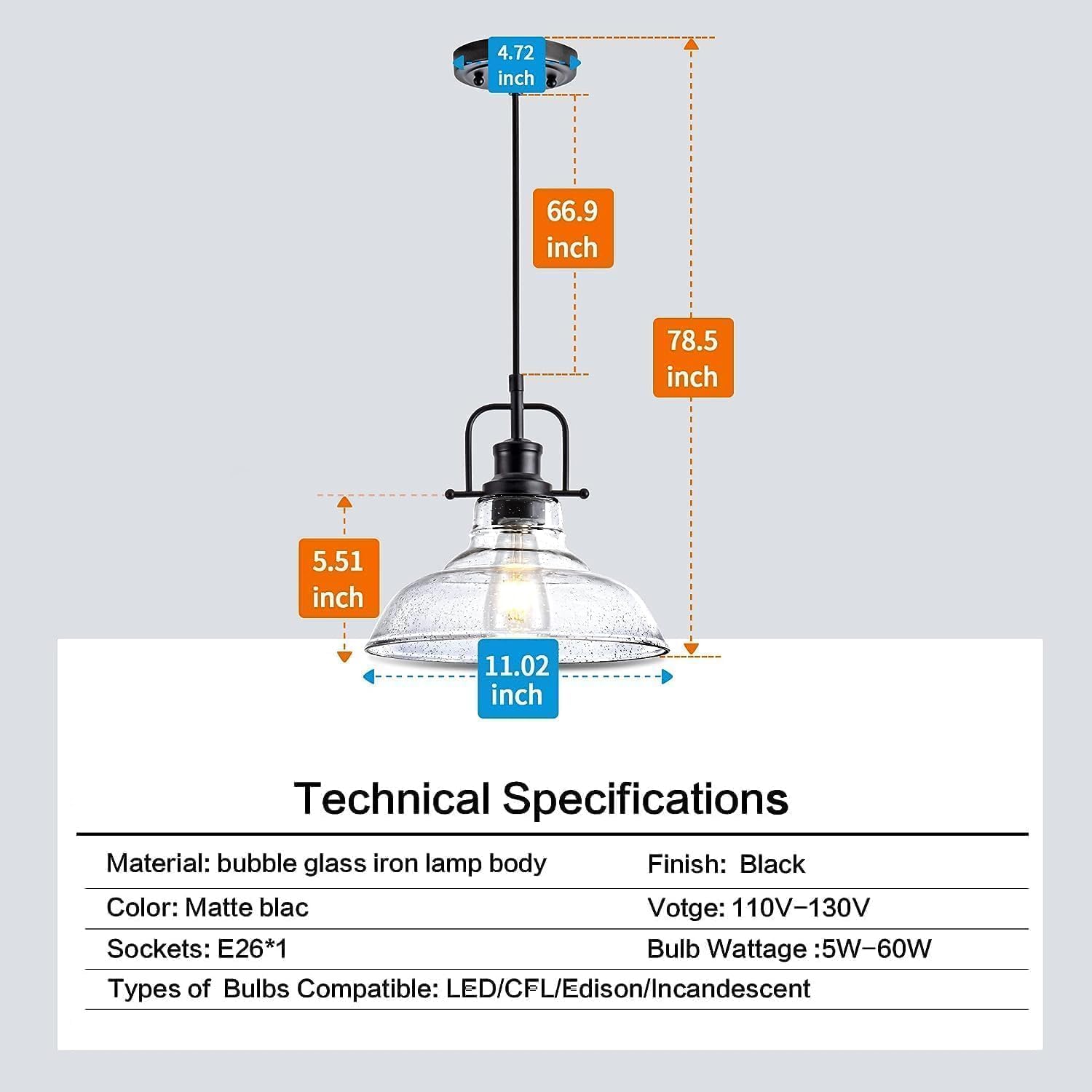
You finally found a pendant that looks exactly right — that soft, old-world warmth of glass that seems to hold light rather than just transmit it. But when it arrives, it looks flat and modern instead of layered and luminous. The culprit, nine times out of ten, is that not all “seeded glass” is the same material made the same way. Seeded glass is glass that contains small trapped air bubbles — the “seeds” — throughout its body. Those bubbles scatter light, creating the gentle, candle-like glow that makes seeded glass pendants so desirable for kitchen islands. But the size, density, and distribution of those bubbles, and whether the glass was formed by a human breath or a machine, determine whether you get an heirloom-looking fixture or a perfectly competent one that still somehow disappoints. This guide breaks down what you’re actually buying, how to pair it with the right metal finish, and how to size everything for a real kitchen.
Mouth-Blown vs. Machine-Pressed: The Distinction That Changes Everything
This is the load-bearing question most product listings bury in the fine print — or skip entirely.
Mouth-blown seeded glass (also called hand-blown) is formed when a glassblower gathers molten glass on a blowpipe and shapes it through a combination of breath, gravity, and hand tools. Air bubbles are introduced either by folding the glass during gathering or by using a batch recipe that encourages bubble formation. The result is irregular: bubbles vary in size, the wall thickness shifts subtly across the globe, and no two pieces are identical. Under a lit bulb, that irregularity reads as depth — the light seems to move inside the glass rather than simply pass through it.
Machine-pressed glass (sometimes called “seeded-look” or “bubble glass” in catalog copy) is poured into a mold under mechanical pressure. Bubbles are added by injecting gas into the molten batch, but the distribution is uniform by design — consistent bubble spacing, consistent wall thickness, consistent everything. The fixture photographs beautifully and can be genuinely attractive at price points under $200, but it reads differently in a room: the light diffusion is more even and less alive.
Apartment Therapy’s breakdown of glass terminology notes that retailers often use “seeded,” “bubbled,” and “textured” interchangeably in product titles, which makes sourcing frustrating. The reliable tell is the product description’s language: look for “hand-blown,” “mouth-blown,” or “individually formed.” If a listing says “seeded glass” without any manufacturing qualifier, and the price is under $150 per pendant, assume machine-pressed until proven otherwise.
Why it matters for kitchen island decisions: If you’re hanging one statement pendant over a small island in a cottage kitchen, the difference between mouth-blown and machine-pressed is visible from the dining table. If you’re running three pendants over a 10-foot island in a bright, open-plan kitchen, the visual mass of three fixtures together does some of the work, and machine-pressed becomes a legitimate option at the $120–$250 per-fixture tier.
What the Bubble Pattern Actually Tells You About Light Output
Seeded glass is a diffuser — it softens and distributes the light from the bulb inside, which is exactly what you want over a kitchen island where glare on countertops is your enemy. But the bubble density and glass thickness determine how much light gets through, and that math matters.
Dense, small-bubble seeded glass (think: the classic apothecary-bottle texture with bubbles roughly 1–3mm) diffuses heavily. You get a warm, soft glow from the exterior of the shade, but less punch as task lighting. These pendants are better suited as ambient contributors paired with under-cabinet lighting or recessed fills, rather than as the island’s sole light source.
Sparse, larger-bubble seeded glass with thinner walls transmits more light with less diffusion. The bubbles are visible but the glass is more transparent overall. These read brighter on the counter below and work better in kitchens where the pendants are doing heavier lifting.
Clear seeded glass — clear base glass with bubbles — is the most versatile: it delivers warmth from the texture without the opacity of amber or smoke seeded glass. Architectural Digest’s 2025 roundup of kitchen pendant picks consistently features clear seeded glass pendants in kitchens where the designer needs warmth without sacrificing lumen output.
By the Numbers: Sizing a Kitchen Island Pendant Run
| Island Length | Pendant Diameter | Number of Pendants | Spacing (center to center) |
|---|---|---|---|
| Up to 5 ft | 8–10 in | 2 | 18–24 in |
| 6–8 ft | 8–12 in | 2–3 | 24–30 in |
| 9–12 ft | 10–14 in | 3 | 30–36 in |
Per This Old House’s kitchen lighting guidance, the bottom of a pendant should hang 30–36 inches above the countertop surface for standard 9-foot ceilings — drop that to 28–32 inches for 8-foot ceilings, and scale up to 36–42 inches for 10-foot-plus ceilings where visual proportion matters as much as function.
Finish Pairings: Where Most Buyers Make the Wrong Call
Seeded glass is forgiving enough to pair with almost any metal finish, which ironically leads to paralysis — and to the most common mistake, which is choosing the finish that matches existing hardware rather than the finish that suits the glass’s warmth register.
Aged brass and unlacquered brass are the natural partners for mouth-blown seeded glass. The warmth of the glass and the warmth of the metal reinforce each other. The critical distinction: aged brass is a factory-applied patina (it’s stable, it won’t change), while unlacquered brass is raw and will oxidize over time toward a darker, more complex tone. In humid kitchens with significant heat variation — high-BTU ranges, dishwashers, open windows — unlacquered brass develops its patina faster. Owners on Houzz project threads consistently report that unlacquered brass over a kitchen island looks noticeably richer at the 18-month mark than at installation, with darkening concentrated around the canopy and cord grip where handling occurs.
Blackened steel and matte black are the right call when the design intent is contrast — the glass reads warmer by opposition, and the fixture has a more graphic, modern-industrial presence. Visual Comfort’s specification sheets for Thomas O’Brien’s Darlana pendant, one of the more specced fixtures in this category at the $400–$600 range, offer the same mouth-blown seeded glass globe in both aged iron and antique brass, which is a useful side-by-side illustration of how the same glass body reads differently across finish families.
Polished nickel and chrome are the most common mismatch with seeded glass. The cool, high-contrast quality of polished nickel fights the glass’s inherent warmth. Rejuvenation’s 2025–2026 catalog pairs their seeded glass pendants almost exclusively with brass and oil-rubbed bronze — the absence of chrome options is an editorial signal worth taking seriously.
Satin brass splits the difference: more controlled than unlacquered, warmer than polished nickel. It’s the right finish when the kitchen has chrome or stainless appliances and you need the pendant to coexist with cool tones without amplifying them. The tradeoff is that satin brass reads flatter over time than unlacquered — it won’t develop the layered patina that makes unlacquered brass fixtures look better at year three than at installation.
Price Tiers and What You’re Actually Getting at Each
After comparing published specs across 40+ fixtures and reading owner reviews, here’s the honest breakdown:
$100–$250 per pendant: Machine-pressed seeded glass is the norm at this tier. The hardware — canopy, cord, socket cluster — is typically zinc alloy rather than solid brass, and the finish is a spray or PVD application rather than a plated or raw metal surface. These fixtures perform well and photograph beautifully. The Houzz community’s kitchen lighting threads are full of satisfying before-and-afters using pendants in this range. The limitation is longevity of the finish (spray brass finishes can chip at cord connection points over 3–5 years) and the flatness of the light diffusion noted above.
$350–$700 per pendant: This is where mouth-blown glass enters consistently. Visual Comfort, Arteriors, and Hudson Valley Lighting all operate in this band. Hardware is typically solid brass or cast iron depending on the finish. The glass is specified as hand-blown on the product page and, importantly, shows the variation in person that justifies the price. Owner reviews across Lumens and YLighting product pages for fixtures in this tier consistently cite the in-person quality exceeding expectations set by product photography.
$800–$2,500+ per pendant: Studio-blown American glass from makers like Matteo, Roll & Hill, or custom work through glassblowing studios represents genuine one-off or small-batch production. Lead times at this tier typically run 10–16 weeks for custom colorways; Rejuvenation’s made-to-order seeded glass pendants in their factory-direct program are currently running approximately 8–12 weeks per their 2025 lead time disclosures. At this tier, the fixture is a design statement — the seeded glass character is maximally present, and the hardware is frequently solid unlacquered brass or hand-forged steel.
Bulb Choice: The Variable Most Guides Skip
The bulb color temperature you put inside a seeded glass pendant changes the glass’s apparent character more than almost any other variable. Seeded glass with a 2200K–2700K bulb (warm white, closer to the amber end) looks like an old gas lantern — deeply warm, slightly amber, romantic. The same glass with a 3000K bulb (which reads as “natural white”) loses that warmth and reads more neutral, closer to frosted glass than to an antique piece.
For most residential kitchen islands, 2700K is the right default. If the kitchen runs cool — white Shaker cabinets, quartzite countertops, stainless appliances — 2700K in seeded glass provides warmth without fighting the palette. The Lighting Design Lab, per their residential specification guidelines, recommends 2700K as the standard for kitchen ambient pendants where diffusing glass is involved, stepping up to 3000K only where task clarity is the primary driver.
Dimmer compatibility is the other variable: seeded glass pendants paired with trailing-edge LED dimmers (recommended over leading-edge for glass fixtures with LED filament bulbs) eliminate the low-end flicker that makes seeded glass look less warm rather than more. Most fixture manufacturers in the $350+ tier specify compatible dimmer models in their installation guides — it’s worth cross-checking before the electrician’s visit.
The Decision Rule
If the pendant is doing ambient work in a kitchen with other light sources — under-cabinet, recessed, natural light — machine-pressed seeded glass at the $150–$250 tier is a rational choice, and you should spend your budget on the finish quality rather than the glass process.
If the pendant is the room’s primary visual statement and one of the island’s main light sources, mouth-blown seeded glass in the $350–$700 range is the right investment. The difference is perceptible daily, not just in photographs.
If you’re speccing for a client project where material provenance is part of the design narrative, the studio-blown tier earns its price. At $800–$2,500+ per pendant, you’re buying a fixture with a traceable making process — which, per Architectural Digest’s 2025 designer roundup, is increasingly how design-forward clients frame the value conversation when reviewing fixture specs.
On finish: choose aged brass when you want stable warmth on day one. Choose unlacquered brass when you want the fixture to develop character with the kitchen. Choose blackened steel when the design needs graphic contrast. Avoid polished nickel unless the glass is clear and the rest of the design is running deliberately cool.
The seeded glass pendant market is genuinely well-served at every price point right now. The buying mistake to avoid isn’t overspending — it’s underspecifying the glass type and being surprised when the fixture arrives looking like something other than what you imagined.