June 6, 2026 • Odalys Ferreira • 9 min reading time • Prices verified June 18, 2026
Seeded Glass Chandeliers for Dining Rooms: Sizing, Finish Patina, and the Kichler Winslow Deep Dive
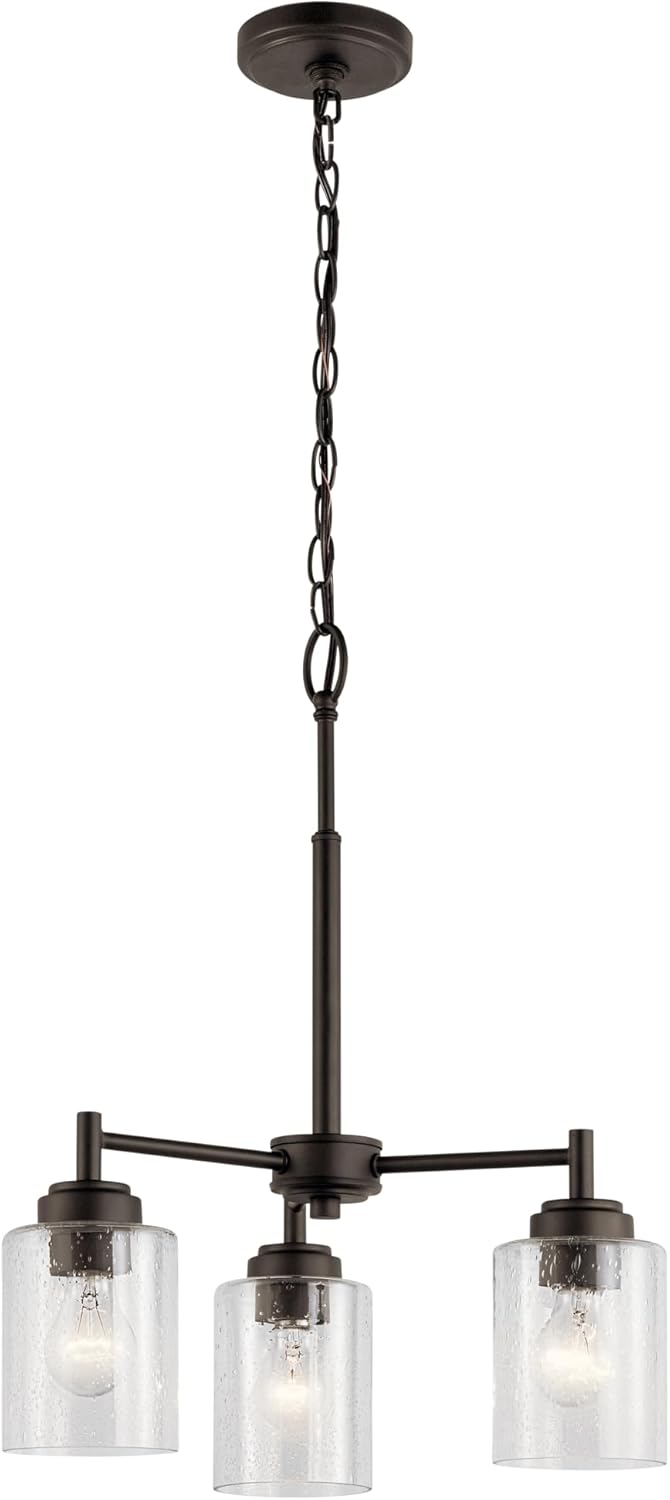
You found the chandelier. It’s got that warm, slightly irregular glass — the kind that makes light look alive instead of just bright. But before you pull the trigger, two questions keep nagging: Will it hang at the right height? And what happens to that beautiful aged-brass finish in five years? Those are exactly the right questions to be asking, and this guide will answer both before walking through the Kichler Winslow specifically — one of the most-discussed seeded-glass chandeliers in the $400–$700 range — with the detail it actually deserves.
Quick definitions for anyone still getting oriented: seeded glass refers to glass that contains intentional small air bubbles suspended throughout the material, created during the blowing process when air is deliberately trapped before the glass sets. This gives the shade a softly animated quality — light scatters instead of transmitting cleanly, so your bulb filament is diffused into something that feels warm and handmade. Mouth-blown seeded glass (found in higher-end fixtures from Rejuvenation, Visual Comfort, and studio makers) is shaped by a human blower, making each piece subtly unique. Machine-pressed seeded glass, used in most mid-market fixtures including the Kichler Winslow, achieves a similar visual effect at significantly lower cost, though the bubbles tend to be more uniform and the walls thicker. Neither is wrong — they serve different design goals and budgets.
| EDITOR'S PICKKICHLER Winslow 14.75" 8 Light… | Mid-tier[Westinghouse 6368400 Belle View](https://www.amazon.com/dp/B07SFJV4QL?tag=greenflower20-20)… | Budget pickKICHLER Winslow 15.25" 3 Light… | |
|---|---|---|---|
| Number of Lights | 8 | 4 | 3 |
| Width | 14.75" | — | 15.25" |
| Finish | Brushed Nickel | Oil-rubbed Bronze | Olde Bronze |
| Price | $414.97 | $241.34 | $115.98 |
| See on Amazon → | See on Amazon → | See on Amazon → |
Sizing the Chandelier to Your Dining Room: The Math That Actually Works
Sizing a dining-room chandelier is where most buyers make a fixable but frustrating mistake. The rules-of-thumb exist for a reason; knowing why they work lets you adjust them intelligently.
The diameter formula. Add your dining room’s length and width in feet; that sum in inches is a reliable starting diameter for the fixture. A 12 × 14 ft. room (26 ft. total) calls for a chandelier roughly 26 inches in diameter. This formula, cited in Houzz’s dining room lighting editorial guide, works because chandelier visual weight needs to fill roughly the same optical field as the room perimeter without overwhelming the table beneath it.
The height formula. This Old House’s chandelier installation guide recommends the bottom of the chandelier hang 30–34 inches above the tabletop for standard 8-ft. ceilings. For every foot of ceiling height above 8 ft., add 3 inches. So a 10-ft. ceiling calls for a hang height of 36–40 inches above the table. This matters acutely with seeded-glass fixtures because the glass shades themselves add visual mass — a fixture that reads as proportional in a catalog photograph can feel oppressive if hung too low.
The table coverage rule. The chandelier’s diameter should be roughly 50–75% of the table’s narrowest dimension. On a 42-inch-wide oval table, that means a fixture between 21 and 31 inches wide. Going wider crowds the sight lines; going narrower makes the fixture look like it was specced for a different project.
By the numbers — quick reference:
| Room Size | Suggested Chandelier Diameter | Hang Height (8-ft. ceiling) |
|---|---|---|
| 10 × 10 ft. | 20 in. | 30–34 in. above table |
| 12 × 14 ft. | 26 in. | 30–34 in. above table |
| 14 × 16 ft. | 30 in. | 30–34 in. above table |
| Any room, 10-ft. ceiling | Add ~3 in. to diameter | 36–40 in. above table |
One nuance that rarely appears in sizing guides: seeded glass reads larger than clear glass at the same diameter because the diffusion obscures the center of the fixture and extends visual mass outward. In practice, owners on Houzz forums report that seeded-glass chandeliers can read 10–15% “heavier” than their spec dimensions suggest. That’s not a reason to go smaller — it’s a reason to measure your drop length carefully and re-evaluate with the chain at the planned hang height before finalizing the install.
Finish Patina: What “Aged Brass” Actually Does Over Time
The finish question is where seeded-glass chandelier buyers frequently underestimate the long game. Architectural Digest’s 2024 feature on dining room lighting notes that finish selection is increasingly the primary design decision for statement fixtures — not glass type, not silhouette. That rings true for seeded glass specifically because the warm amber tones of the glass interact differently with warm-metal finishes (brass, bronze) versus cool or dark ones (blackened steel, matte black).
Here’s the distinction that matters: lacquered brass is sealed with a clear protective coat that freezes the finish at its factory state. Unlacquered brass is raw metal that will oxidize and patina over months to years, shifting from bright gold toward amber, then toward a complex green-bronze in humid environments. The Kichler Winslow is offered in a lacquered “natural brass” finish — meaning it won’t develop a meaningful patina, which is a deliberate choice for buyers who want predictable maintenance. That’s not a compromise; it’s a different product category.
For buyers who want the living patina of unlacquered brass, the tradeoffs are explicit:
- In low-humidity inland climates (Denver, Phoenix, Chicago winters), unlacquered brass on a fixture darkens slowly and evenly. Owner reports aggregated from Houzz fixture reviews suggest the shift from bright to honey-amber takes roughly 18–30 months.
- In coastal or high-humidity environments (Miami, Houston, coastal New England), the same process accelerates to 6–12 months and introduces the risk of green verdigris in crevices. Owners consistently report that fixtures with complex castings — multiple arms, decorative joiners — develop uneven patina that’s difficult to manage.
- Blackened steel and matte black finishes are the maintenance-free alternative: they don’t oxidize visibly and require only occasional dusting. The tradeoff is reduced warmth — they work best when the room has warm wood tones that carry the temperature the finish doesn’t provide.
Apartment Therapy’s materials explainer on seeded glass notes that the glass itself doesn’t change with age under normal conditions, which means if you invest in a solid fixture with good bones, the glass component will outlast multiple finish cycles. That’s worth keeping in mind if you’re considering a refinish in 7–10 years.
The Kichler Winslow: What the Specs Say and What Owners Report
The Kichler Winslow (catalog numbers vary by configuration — the 5-light version is the most commonly reviewed) has become a reliable mid-market reference point precisely because it’s widely stocked, broadly reviewed, and priced at a tier ($450–$650 at time of publication, depending on finish and configuration) where the gap between expectation and delivery is large enough to matter.
What the spec sheet tells you. The Winslow’s shades are machine-pressed seeded glass — not mouth-blown, and Kichler’s documentation doesn’t describe them otherwise. The bubbles are evenly distributed, the walls are consistent in thickness, and the finish on the glass reads as slightly amber-tinted rather than water-clear. Published specs put the 5-light version at approximately 27 inches in diameter and 25 inches in height, with a 60-inch adjustable stem. It’s UL-listed for damp locations (meaning it can be installed in covered outdoor dining areas or high-humidity kitchens, though not in direct moisture). The fixture uses candelabra-base (E12) bulbs — an important detail because this limits your lumen output per bulb and your dimming flexibility.
What owners consistently report. Across aggregated reviews on Houzz and major lighting retailers, the pattern is consistent: the Winslow delivers a warm, flattering light quality that reviewers describe as “romantic” and “better than expected for the price.” The seeded glass does its job — filament bulbs scatter beautifully, and even LED filament bulbs (2200–2700K color temperature recommended for this glass type) produce the warm-amber effect that makes seeded glass worth choosing in the first place. The assembly process draws mixed reviews; owners report that the chain adjustment and canopy fit are workable but not as refined as fixtures at the $900+ tier. The finish — most reviews are of the natural brass version — holds cleanly with standard cleaning.
The one consistent complaint: owners in rooms at the larger end of the sizing range (12 × 14 ft. and above) report that the Winslow’s 27-inch diameter reads small. This tracks with the visual-mass principle above — the seeded glass fills the fixture’s diameter well, but the overall form doesn’t expand to fill larger dining rooms. For those rooms, the 8-light Winslow variant (approximately 32 inches in diameter) or a step-up fixture is the better call.
Honest positioning. The Winslow is a capable, well-priced seeded-glass chandelier for dining rooms in the 10 × 12 to 12 × 14 ft. range with 8-ft. ceilings. It is not a craft piece. The machine-pressed glass won’t have the subtle variation of a mouth-blown shade, and the hardware quality reflects its price point. For buyers at the $1,000–$2,500 tier looking for genuine artisan character, Visual Comfort’s Alexa Hampton collection and Rejuvenation’s seeded-glass pendants offer mouth-blown shades and hardware refinement that justify the price difference. For a first dining-room chandelier or a rental refresh where design impact per dollar matters, the Winslow earns its reputation.
The Decision Frame: If X, Then Y
After comparing specs and owner feedback across this category, here’s how the decision actually breaks down:
If your dining room is under 12 × 14 ft. with 8-ft. ceilings and you want a clean, warm seeded-glass look without a craft-piece budget: The Kichler Winslow 5-light is the right call. Buy it with candelabra-base LED filament bulbs at 2200–2400K and a compatible dimmer — Lutron’s Diva CL series is the most-cited match for E12 candelabra fixtures in aggregated owner forums.
If your room is 14 × 16 ft. or larger, or your ceilings are 10 ft.+: Move to the Winslow 8-light or step up to the $900–$1,400 tier. At that size, the fixture’s visual presence needs to scale, and the Winslow 5-light will disappoint regardless of how correctly you hang it.
If finish patina matters to you and you want the living character of aging metal: The Winslow’s lacquered brass is not your product. Budget for Visual Comfort or Rejuvenation, or source an unlacquered-brass fixture from a maker who specifies the metal clearly, and plan for the maintenance that comes with it.
If you’re speccing for a client project where material provenance and hand-craftsmanship need to be part of the conversation: The Winslow doesn’t belong in that conversation. Roll & Hill, Urban Electric Co., and Apparatus are the reference points at that tier — where the story of the glass is as important as the light it throws.
The core insight across all three segments: seeded glass rewards correct bulb selection and precise hang height more than almost any other fixture type. Get those two variables right, and even a mid-market piece performs well above its price point. Get them wrong, and a $2,000 fixture will underwhelm every dinner party.