June 8, 2026 • Odalys Ferreira • 10 min reading time • Prices verified June 18, 2026
Multi-Light Island Chandeliers with Seeded Glass: Linear vs. Round, and How to Match the Fixture to Your Table
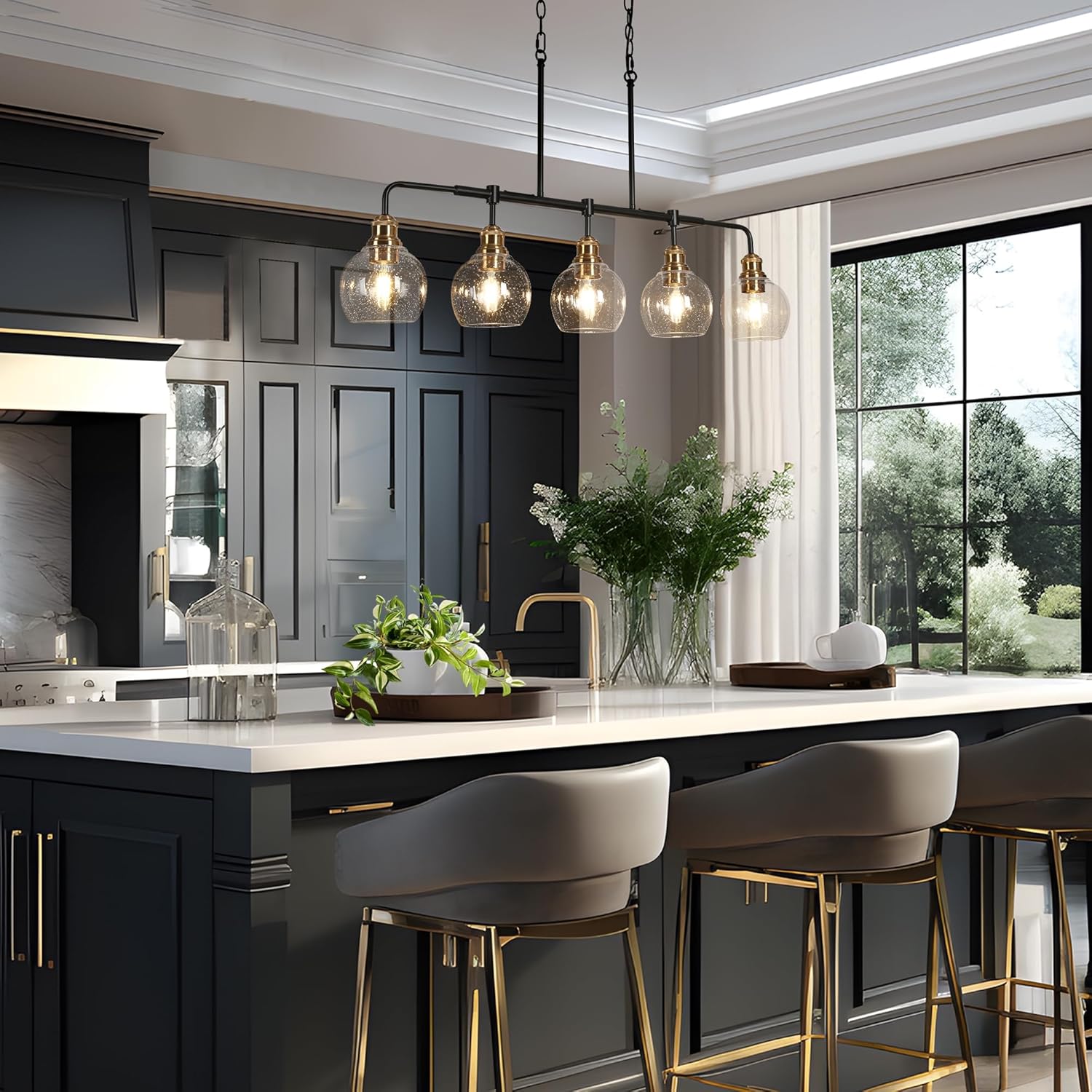
You finally found the island chandelier that stops the scroll — a row of amber-tinted pendants or an arching multi-arm fixture with small glass globes — and now you’re staring at a spec sheet trying to figure out whether it actually works above your table. The two decisions that trip people up most are form factor (linear bar versus round canopy) and glass type — specifically, whether that “seeded” glass you keep seeing listed is the warm, handmade-looking material you’re imagining, or something else entirely. Seeded glass is mouth-blown or machine-pressed glass that traps small air bubbles inside the walls, scattering light in a soft, slightly unpredictable way that solid clear glass never does. It reads warmer, more artisan, and more forgiving of bright bulbs. This guide walks through exactly how to choose between linear and round configurations and how to match either one to your table dimensions, ceiling height, and finish palette — with the math shown at every step.
| EDITOR'S PICK[Kichler Grand Bank 4-Light Chan…](https://www.amazon.com/dp/B00AJP75IG?tag=greenflower20-20) | Mid-tier[Glass Cluster Chandelier 5-Ligh…](https://www.amazon.com/dp/B0CKN1Y3ND?tag=greenflower20-20) | Budget pick[EAPUDUN 3-Light Kitchen Island…](https://www.amazon.com/dp/B08BRF7JCK?tag=greenflower20-20) | |
|---|---|---|---|
| Number of lights | 4 | 5 | 3 |
| Dimensions (WxHxD) | 20" x 90" x 20" | — | 35.4" long |
| Glass type | Clear Seeded | Seeded Bubbles | Seeded Bubble |
| Shape | — | Round (Cluster) | — |
| Finish | Auburn Stained Wood / Distressed Black | — | Black / Dark Bronze |
| Price | $771.99 | $257.50 | $149.99 |
| See on Amazon → | See on Amazon → | See on Amazon → |
Linear vs. Round: The Decision Is Mostly About Your Table
The shape question sounds aesthetic, but it’s almost entirely functional at its core. A linear multi-light chandelier — a horizontal bar or rod with two to six pendants or shades spaced along its length — is engineered for a surface that runs long in one direction: a rectangular dining table, a galley-style kitchen island, or a breakfast counter. A round or cluster chandelier — a central canopy from which arms or cords radiate outward in roughly equal directions — is designed for a surface whose footprint is roughly square or circular, because it distributes light symmetrically in all directions.
Getting this wrong is a common and expensive mistake. Architectural Digest’s room-sizing guide for chandeliers consistently identifies the mismatch between a round chandelier centered on a rectangular table as one of the most frequent lighting errors in kitchen renovations: the fixture lights the center and leaves both ends dim, and it reads visually narrow against the table’s long axis. The inverse problem — a linear fixture above a round table — creates uneven illumination on the sides and can feel architecturally aggressive, like a bar light dropped into the wrong room.
The practical rule: If your table or island is at least 1.5× longer than it is wide, go linear. If the ratio is closer to 1:1 (within 20%), a round or cluster fixture is your better match.
Linear Fixtures: Specs, Sizing, and the Three Tiers Worth Knowing
Linear island chandeliers with seeded glass span a wide range, from commodity-tier imports to studio-made American pieces. The variables that matter most are overall width relative to table length, pendant spacing, and canopy type.
Overall width vs. table width: The fixture should run roughly 60–70% of the table’s total length, per This Old House’s kitchen lighting reference, “Lighting a Kitchen Island: What You Need to Know.” On a 72-inch table, that puts your target fixture width at approximately 43–50 inches. Going narrower makes the fixture look lost; going wider than 80% of table length crowds the visual field and risks interference with chairs at the ends.
Pendant spacing and quantity: A three-light linear fixture over a 48-inch island versus a five-light version over a 72-inch island produces noticeably different pools of overlapping light. Seeded glass diffuses each bulb’s output compared to clear glass, which means closer pendant spacing produces soft overlap rather than harsh convergence.
Canopy type: A single-canopy linear design accepts one ceiling junction box and is simpler to install. A two-canopy linear with independent ceiling anchors allows leveling on sloped ceilings but requires two junction boxes — a meaningful rough-in cost if you’re at the pre-drywall stage.
Budget Linear Pick
At the entry tier ($250–$550), machine-pressed seeded glass is standard. Fixtures in this range typically offer two to three pendants on a fixed bar in 36–48-inch widths, with adjustable cord lengths up to 48 inches. Finishes tend toward matte black or brushed nickel. Adequate for a 48-inch island when surface is not a primary prep zone.
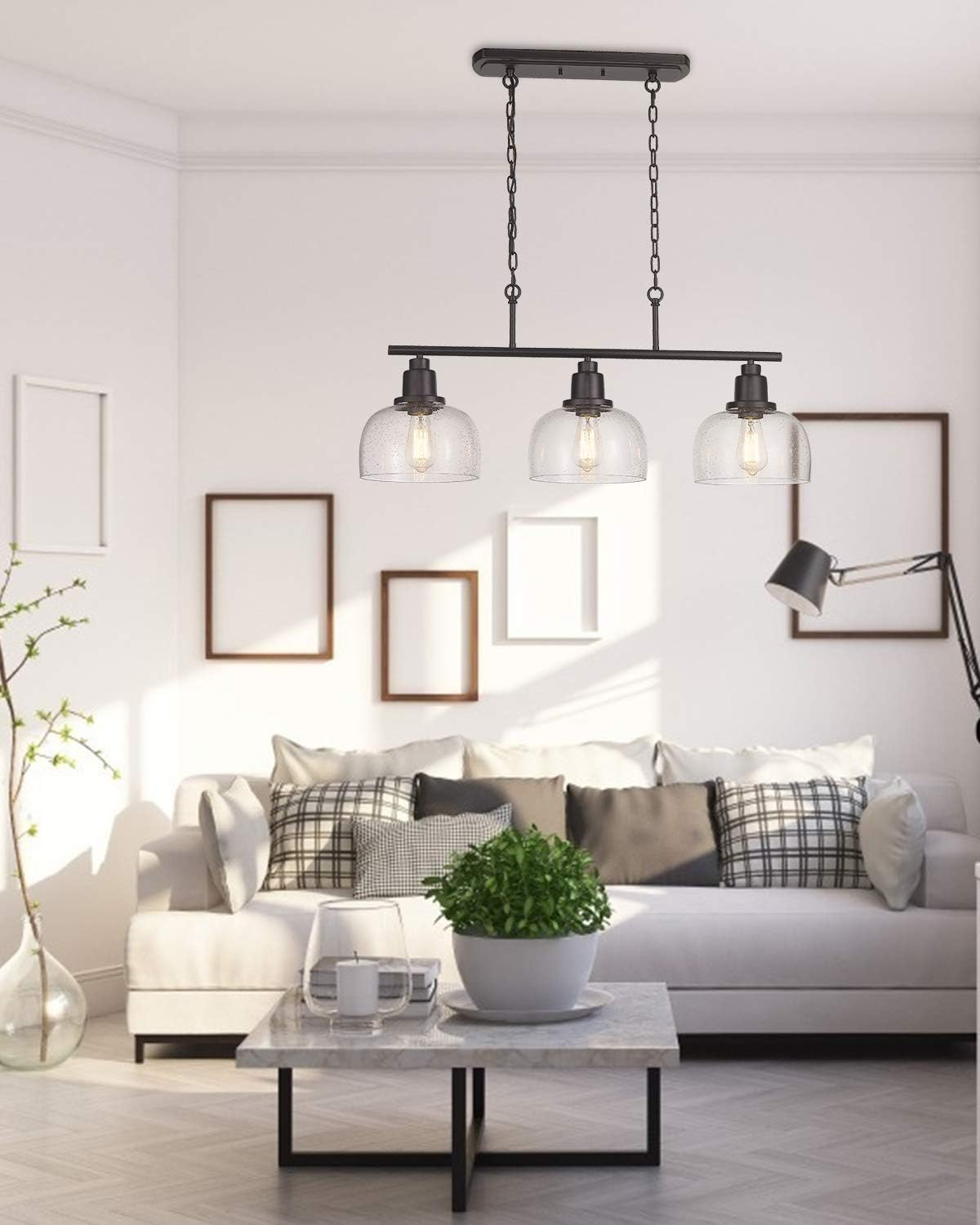
EAPUDUN
$149.99
In stock on Amazon
Check price on AmazonMid-Tier Linear Pick
In the $600–$1,200 range, you begin to see improved glass quality — more irregular bubble distribution, thicker glass walls, and better canopy hardware. Hudson Valley Lighting’s linear collections and comparable mid-tier lines offer three- to five-light configurations in 42–60-inch widths, with aged brass and blackened steel finish options. Glass globes in the 5–7-inch diameter range provide enough seeded glass volume to soften 40–60W-equivalent bulbs comfortably.
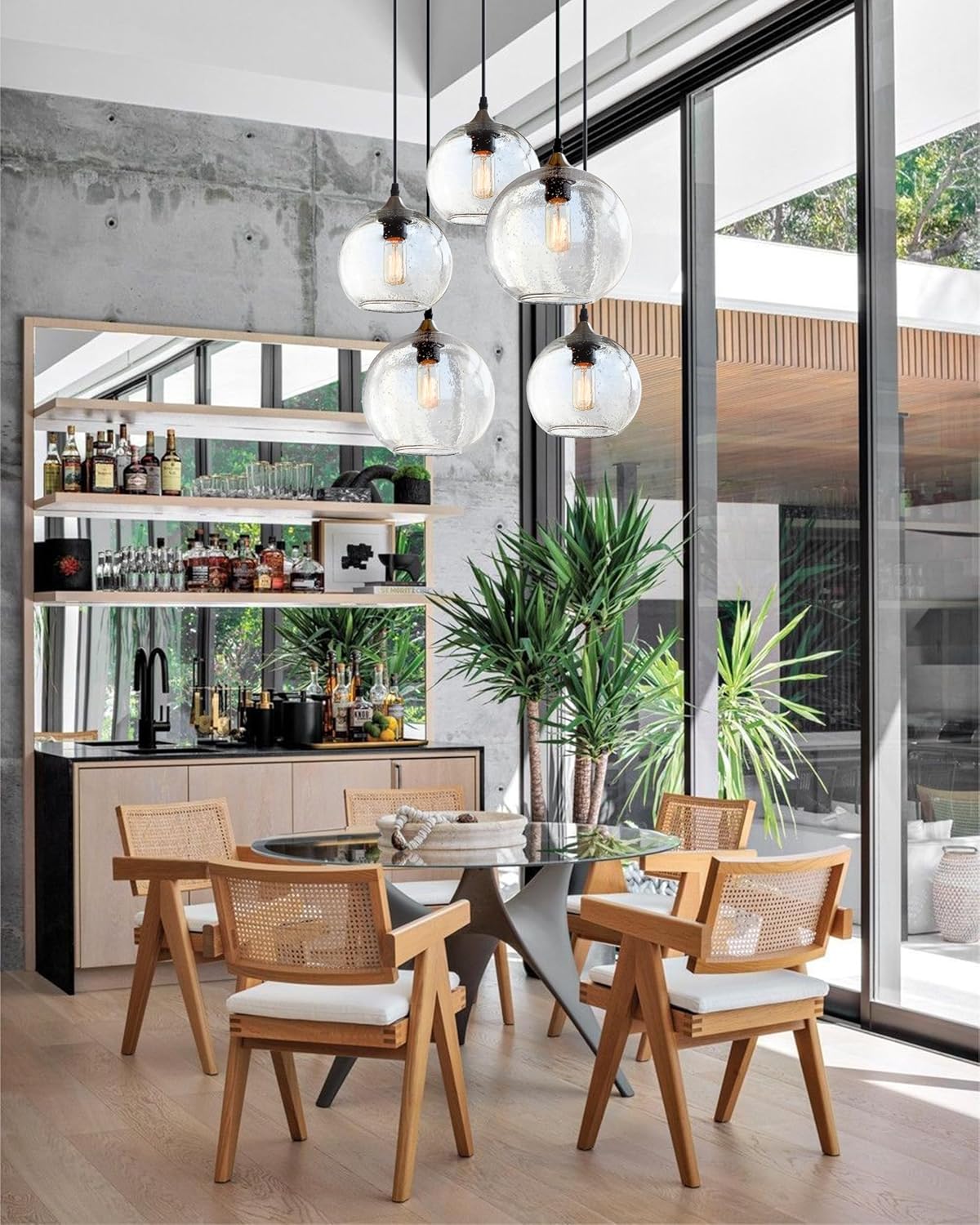
Glass
$257.50
In stock on Amazon
Check price on AmazonPremium Linear Pick
At $1,300 and above — fixtures from Visual Comfort’s Studio collection, Roll & Hill, or hand-fabricated American studio pieces — mouth-blown seeded glass is where the price premium lives. Bubble distribution is irregular and organic. At close range (a banquette seat 18 inches from the fixture), the difference between mouth-blown and machine-pressed is immediately visible. These fixtures also carry longer adjustable stem options (up to 72 inches), making them the correct choice for 10-foot or taller ceilings where entry-tier cords max out prematurely.
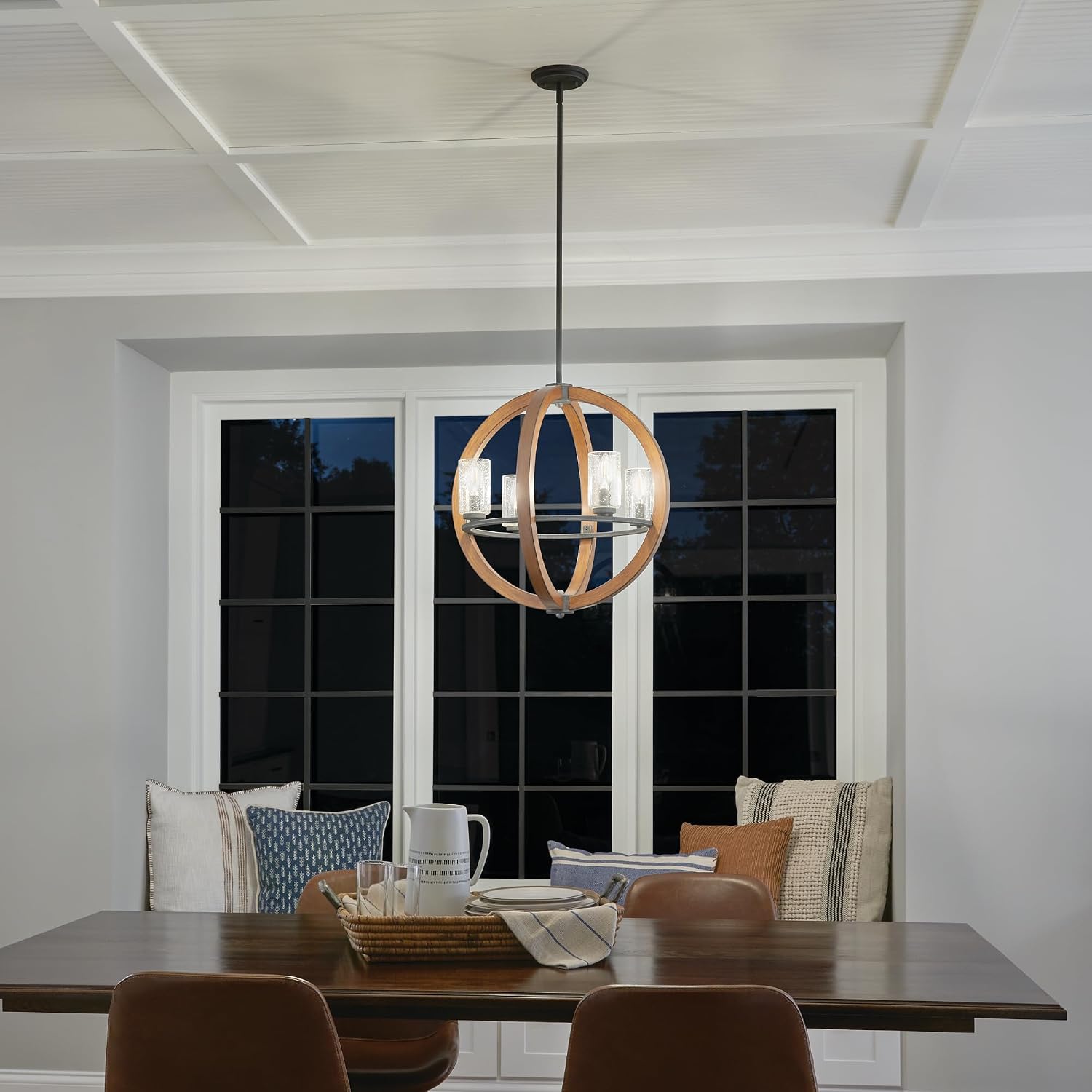
Kichler
$771.99
In stock on Amazon
Check price on AmazonRound and Cluster Fixtures: Configuration Trade-offs Across Three Tiers
Round multi-light fixtures vary more in how their arms or cords are arranged than in their basic canopy mechanics. The key variants are sputnik/radial arm clusters, multi-pendant round canopy clusters, and wagon wheel/hoop chandeliers.
Sputnik / radial arm clusters project arms outward from a central hub at roughly equal angles, often with small seeded glass globes at each tip. These work well on 8- to 9-foot ceilings because the fixture occupies vertical space efficiently. The tradeoff: arm-end glass globes are typically 3–6 inches in diameter, so each light source is a relatively concentrated point. Seeded glass helps significantly here — it softens the visible filament and reduces glare compared to clear glass on the same bulb.
Multi-pendant round canopy clusters hang three to six pendants from a round ceiling canopy at varying or identical lengths. Houzz’s kitchen lighting guidance identifies warm-white bulbs at 2,700K–3,000K as the preferred pairing for seeded glass because the slight amber tint of seeded glass shifts a warm-white bulb toward amber-gold rather than yellow. This configuration allows more glass volume per light source and is well-suited to dining rooms where ambience outweighs pure task output.
Wagon wheel / hoop chandeliers distribute light outward as well as downward, making them better for ambient fill over a dining table than for focused task lighting over a prep island. If your island doubles as a serious prep surface, this configuration requires supplemental undercabinet lighting more than the others.
Budget Round Pick
Entry-tier round or cluster fixtures ($200–$450) typically feature machine-pressed seeded glass in the 3–5-inch globe range, with four to six arms and a simple stamped-metal canopy. These perform well in 8-foot ceilings above a 36–42-inch round table. Finish options are usually limited to matte black or aged bronze.
EAPUDUN
$149.99
In stock on Amazon
Check price on AmazonMid-Tier Round Pick
Mid-tier round clusters ($500–$1,100) show improved arm joinery, heavier canopy castings, and access to unlacquered brass and satin nickel finishes that interact more authentically with the seeded glass’s warmth. Globe diameter moves up to 5–8 inches, which delivers meaningfully more diffused light output per pendant position. Feiss, Mitzi, and comparable lines occupy this space reliably.
Glass
$257.50
In stock on Amazon
Check price on AmazonPremium Round Pick
Premium round fixtures ($1,200–$3,000+) from Visual Comfort, Apparatus Studio, or custom American fabricators use mouth-blown seeded glass with genuinely irregular bubble patterns. At this tier, canopy hardware is often solid brass rather than plated zinc, and finish durability (particularly on unlacquered brass) is substantially better over the fixture’s life. These fixtures are appropriate for client-facing projects and spaces where someone will be seated close enough to read the glass at dinner.
Kichler
$771.99
In stock on Amazon
Check price on AmazonSeeded Glass: Mouth-Blown vs. Machine-Pressed
Not all seeded glass is created equal, and conflating mouth-blown and machine-pressed seeded glass is the single most common terminology error in fixture purchasing. Dwell’s coverage of current glass lighting trends, “Glass Lighting Trends: Seeded, Ribbed, and Mouth-Blown Fixtures,” puts this distinction clearly: mouth-blown seeded glass has irregular bubble distribution — bubbles cluster slightly, vary in size, and create a subtly organic pattern that machine-pressed glass cannot replicate. Machine-pressed seeded glass has uniform, evenly spaced bubbles in a consistent pattern, which reads more graphic and less artisan at close range but is indistinguishable from most viewing distances in a dining room or kitchen.
Finish pairing: Seeded glass’s amber-warm tone interacts with metal finish in ways that clear glass does not. Aged brass and unlacquered brass amplify the warmth, reading richly in traditionally styled kitchens and transitional dining rooms. Blackened steel or matte black shifts the reading toward contemporary-industrial — the glass appears cooler against dark metal, which can be exactly right for a modern kitchen but feels slightly dissonant in a warmer space. Polished or satin nickel sits in the middle, remaining neutral against the glass’s inherent warmth.
One additional glass note: do not confuse seeded glass with opaline glass. Opaline is a fully opaque white glass that blocks significantly more light. It is better suited to ambient positions than task lighting over a prep island.
The Hanging Height Calculation
The IES Illuminating Engineering Society’s Residential Lighting Handbook provides the underlying framework that most retailers simplify: the bottom of your fixture should hang 30–36 inches above the tabletop surface for a dining table where people sit, and 36–42 inches above a working kitchen island counter (to clear sightlines and avoid head clearance issues). These are bottom-of-shade measurements, not canopy height.
| Ceiling height | Surface height | Target bottom-of-fixture (AFF) | Cord/rod length needed |
|---|---|---|---|
| 8 ft (96 in) | 30 in (dining table) | 66 in AFF | ~30 in |
| 9 ft (108 in) | 36 in (island counter) | 72–78 in AFF | ~30–36 in |
| 10 ft (120 in) | 30 in (dining table) | 66 in AFF | ~54 in |
“AFF” = above finished floor. Cord and rod lengths are calculated from canopy to bottom-of-fixture. Confirm the manufacturer’s maximum stem or cord length before ordering — many entry-tier fixtures top out at 48-inch adjustable cords, which is insufficient for 10-foot ceilings.
Apartment Therapy’s island lighting reference, “The Right Way to Hang a Light Over Your Kitchen Island,” adds one consideration that spec sheets omit: if the fixture has exposed cords or rods between pendants, the visual weight of those elements changes meaningfully at different hanging heights. A linear bar fixture with six inches of visible pendant drop looks intentional at 30 inches above the table; at 48 inches, the short pendants look undersized and the bar appears to float disconnected from the surface.
The Decision Framework
If your table is rectangular (longer than 1.5× its width) and 48–72 inches long: choose a 3- to 4-light linear fixture running 60–70% of table length. Reference This Old House’s kitchen lighting sizing guidance and confirm cord length against your ceiling height before ordering.
If your table is square or round (ratio within 1.2:1) and seats 4–6: choose a round cluster or radial fixture in the 18–24-inch diameter range. Sputnik configurations work best on standard 8-foot ceilings. Multi-pendant round canopies give more seeded glass volume if warmth and diffusion are priorities, per Houzz’s kitchen lighting advice.
If the space is a kitchen island doubling as a prep surface: prioritize lumen output. Seeded glass with clear mouth-blown globes (4–6 inches diameter, three to five lights) at 2,700K gives adequate task light with enough warmth to feel residential rather than commercial.
If ceiling height is under 8 feet: skip multi-pendant drop configurations and look for semi-flush linear or cluster designs with minimal pendant drop. Hanging height miscalculations on low ceilings are among the most-returned fixture categories in the market — use ceiling-height filters on any reputable retailer’s site before shortlisting.
On finish: Aged brass or unlacquered brass paired with seeded glass is the combination Houzz reader reviews and Apartment Therapy’s kitchen round-ups most consistently describe as the warmest and most livable. If your kitchen has cool undertones — gray stone, white shaker, stainless appliances — balance with matte black or satin nickel to avoid reading too amber-heavy under evening lighting. The glass does the warmth work; the finish controls how much of that warmth the fixture projects into the room.
The honest bottom line: the linear-versus-round question is settled by your table shape. Everything else — glass quality, finish, hanging height — is where your budget and your tolerance for getting the details right determines whether the fixture just works or actually defines the room.